Late Autumn Road Trip to Bipenggou: A Weekend Escape for Two, a Serendipitous Encounter with Red Leaves, Snowy Peaks, and Good Fortune
Meta Description: Discover the magic of a late autumn road trip to Bipenggou from Chengdu. This weekend escape for two reveals red leaves, snowy peaks, unexpected detours, and good fortune. Read our SEO-optimized travel guide.
Introduction: Why a Spontaneous Bipenggou Road Trip is the Ultimate Autumn Escape
Since starting work, the most luxurious thing hasn't been buying a handbag—it's stealing away two idle days from the grind of life. That weekend at the end of October 2012, my sister and I spontaneously decided to hit the road for a getaway. Our destination: Bipenggou, a stunning valley in Li County, Sichuan, renowned for its autumn foliage, snow-capped peaks, and serene Tibetan-Qiang culture.
Originally a foursome, it was just the two of us after our other friends got tied up with work. Honestly, before we left, I had my doubts: two people, one car, and me doing all the driving—would it be too exhausting? But then I thought, as long as I could escape Chengdu's smog and see some blue sky, even a short trip nearby would be worth it.
As it turned out, this impromptu short getaway became the most stunning memory of that autumn. Looking back now, the traffic jams, the long queues, the cramped sightseeing buses—all those hassles have become the most amusing footnotes to the story.
H2: Pre-Trip Preparation for a Bipenggou Weekend Escape

H3: The Hasty Excitement Before Departure
After work on Friday, my sister and I rushed into the supermarket, grabbing snacks and bottled water as if we were preparing for a wilderness survival mission. Amazingly, we ended up packing a huge suitcase for just two people and two days away—anyone would have thought we were moving house.
On the morning of the 28th, we set off promptly at 8:30. But we hadn't even cleared the Third Ring Road before we hit a traffic jam. The radio station 101.7 FM reported that the weather was so beautiful that everyone in Chengdu had decided to go out, and the Dujiangyan-Wenchuan Expressway was completely gridlocked. We weren't too bothered, though—we had the right mindset: if we couldn't make it to our destination, that was fine too. We'd just go wherever the road took us.

Once we got on the Chengdu-Dujiangyan Expressway and tried to merge onto the Dujiangyan-Wenchuan Expressway, the traffic police had already closed the entrance. No choice but to exit at Dujiangyan and take the national highway instead. But neither of us knew the way. We drove around Dujiangyan city several times before finally finding the right route. A straight road took us all the way to Wenchuan, just in time for lunch.
While eating, we chatted with the restaurant owner, who told us the expressway wasn't officially open yet. But if we were lucky, he said, and talked nicely to the tollbooth staff, we might just get through. We made a mental note to try our luck on the way back.
[Link: Best time to visit Bipenggou for autumn foliage]
H2: First Surprise: The Quiet Charm of Qiangren Valley
After lunch, we continued on, and the first place that truly amazed us appeared—Qiangren Valley (Qiang People's Valley).
There were very few people here, and it felt as quiet as if time had forgotten it. Little bridges over flowing water, sunlight filtering through the leaves, the whole village bathed in a lazy, serene atmosphere. Standing on a bridge, I thought to myself: if only I could stay here for a few days, think of nothing, have no worries—how wonderful that would be.
I heard this place was modeled after Taoping Qiang Village, but I found it had more character. Maybe it was because there were so few people. That untouched quiet made you reluctant to speak above a whisper. Unfamiliar little flowers by the roadside sparkled in the sun, and a few Qiang children chased each other through the alleys—a scene as beautiful as an oil painting.
The only hiccup: the sun was too bright, and all our photos were overexposed. But that didn't matter. Some landscapes are enough just to have seen with your own eyes.
[Link: Top attractions in Qiangren Valley]
H2: Taoping Qiang Village: A Forty-Yuan Surprise
Not long after leaving Qiangren Valley, we arrived at Taoping Qiang Village. An elderly Qiang woman at the entrance asked if we wanted to stay overnight. We said no. Then she asked if we wanted her to sneak us in—forty yuan each, instead of the regular sixty. My sister and I exchanged a glance, and followed her without a second thought.
The surprise didn't end there. Not only did she take us in, but she also had her daughter act as our guide. We saved forty yuan and got a free tour guide—what incredible luck.
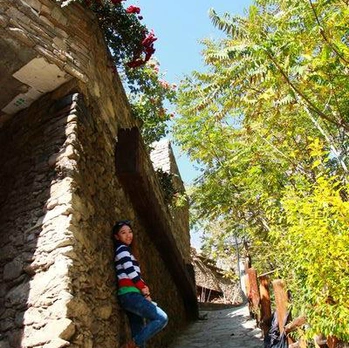
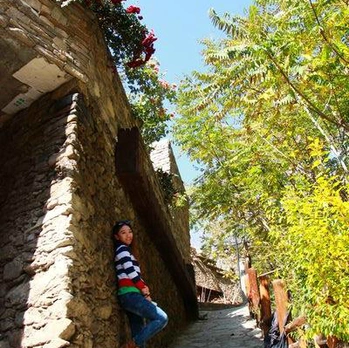
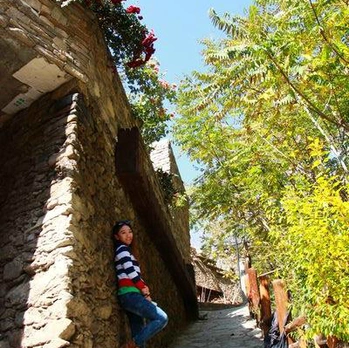
Taoping Qiang Village, called "Qizi" in the Qiang language, sits on a mountainside between Wenchuan and Li County, built against the slope. It's a classic example of Qiang architecture, with mountains at its back and water at its front, facing south with a north-south orientation, laid out in a tight, orderly plan. Within the village stand two nine-story stone watchtowers, built from piled stone blocks, facing a beacon tower on the opposite mountain peak. All the buildings are constructed from piled stone, with watchtowers dotting the landscape, earning it the title of the most mysterious "Ancient Eastern Castle."
Walking on the flagstone paths of the old village, my legs were shaking—not from excitement, but from fear of heights. Looking down from the watchtower, my knees went weak. My sister laughed so hard she nearly doubled over, saying my pathetic expression was more entertaining than the scenery.
Every household in the village flew red flags from their rooftops. There was a kindergarten, flowers in the courtyards, stalls selling pumpkins, and embroidered shoes—the moment I saw those shoes, I thought of horror movies and quickly dragged my sister away. This place was also a filming location for the movie The Chef, the Actor, the Scoundrel. I hadn't seen it, but standing in front of those old houses, you could feel an indescribable sense of stories hidden within.
[Link: History of Taoping Qiang Village]
H2: Ganbao Tibetan Village: Bonfire Night and Unexpected Luck
By the time we left Taoping Qiang Village, it was nearly 6 PM. We pressed on, heading straight for our overnight stop—Ganbao Tibetan Village.
Ganbao Tibetan Village is located in the central section of the hundred-mile Tibetan-Qiang cultural corridor between Li County and Barkam, right next to National Highway 317. It's 192 kilometers from Chengdu and 8 kilometers from the county seat of Li County. This is a typical large village inhabited by the Jiarong Tibetans, built against the mountain and beside the river. "Ganbao" means "village on the slope" in Tibetan.
By the time we arrived, it was almost dark. We dragged our suitcases and found a random place to stay—100 yuan per person, including dinner and breakfast. After dropping off our things, we weren't hungry yet, so we went out for a stroll. Sichuan people are tough—no matter where they go, they never forget their national pastime: mahjong. Even in this Tibetan village, there were mahjong tables, with a few aunties playing enthusiastically.
When we got hungry and went back for dinner, the landlady told us there was a bonfire party down below. We finished eating quickly and rushed over to join the fun. It wasn't exactly a proper bonfire party—more like a casual dance gathering, a bit chaotic but full of great atmosphere. My sister took a photo of me in the firelight that turned out really well—I loved it.
Back at our lodging, the courtyard was hung with corn, giving it a strong New Year's vibe reminiscent of Northeast China. As we were admiring it, we ran into a group of tourists just back from Bipenggou. They said the scenic area had been incredibly crowded that day—they'd waited an hour and a half just to board the sightseeing bus, and many people who hadn't bought tickets in advance were turned away by around 10 AM.
My sister and I panicked. We immediately asked the landlady if she could help us get tickets. She made a few phone calls and said it was too late—tickets could have been arranged before 5 PM, but now the office was closed. No luck.
No choice but to go to bed early. The next morning, we woke up at 5 AM, had breakfast a little after 6, and set off in the dark.
[Link: Accommodation options in Ganbao Tibetan Village]
H2: Bipenggou: A Race Against Time
As soon as we arrived at the parking lot, we saw a crowd gathered around. We went over to check it out and found out it was a tour group—and the guide still had a few extra tickets. We snapped them up without hesitation. Our luck had turned.
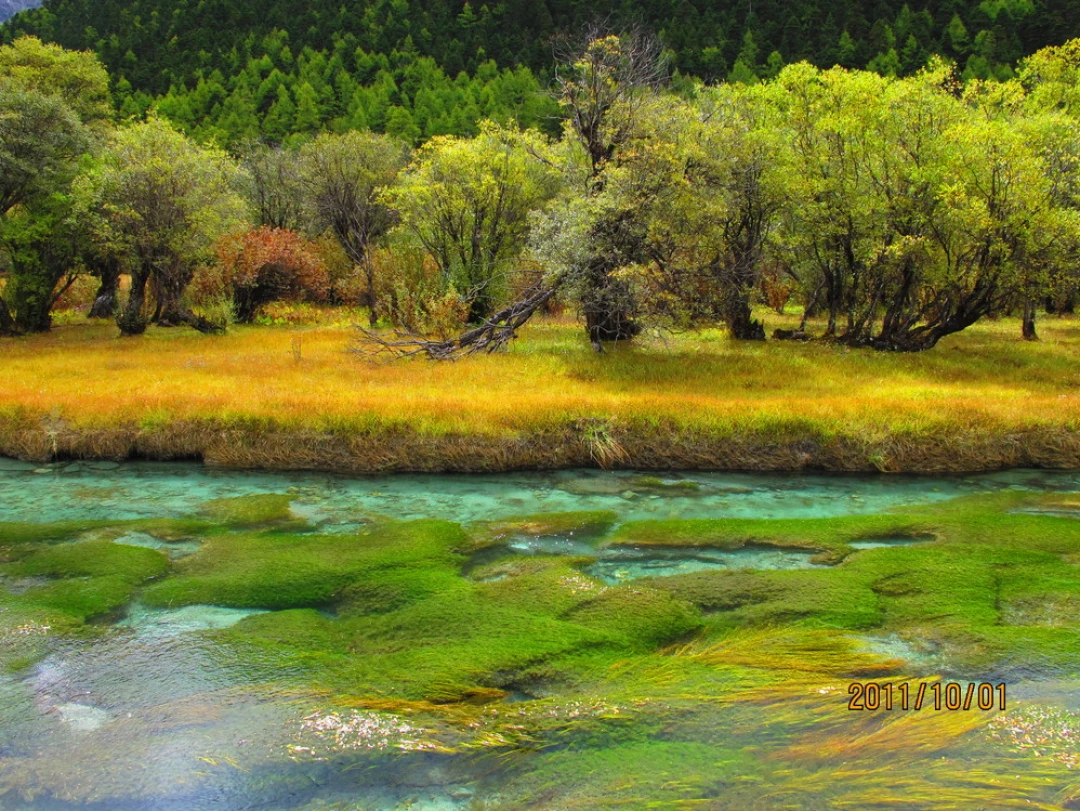
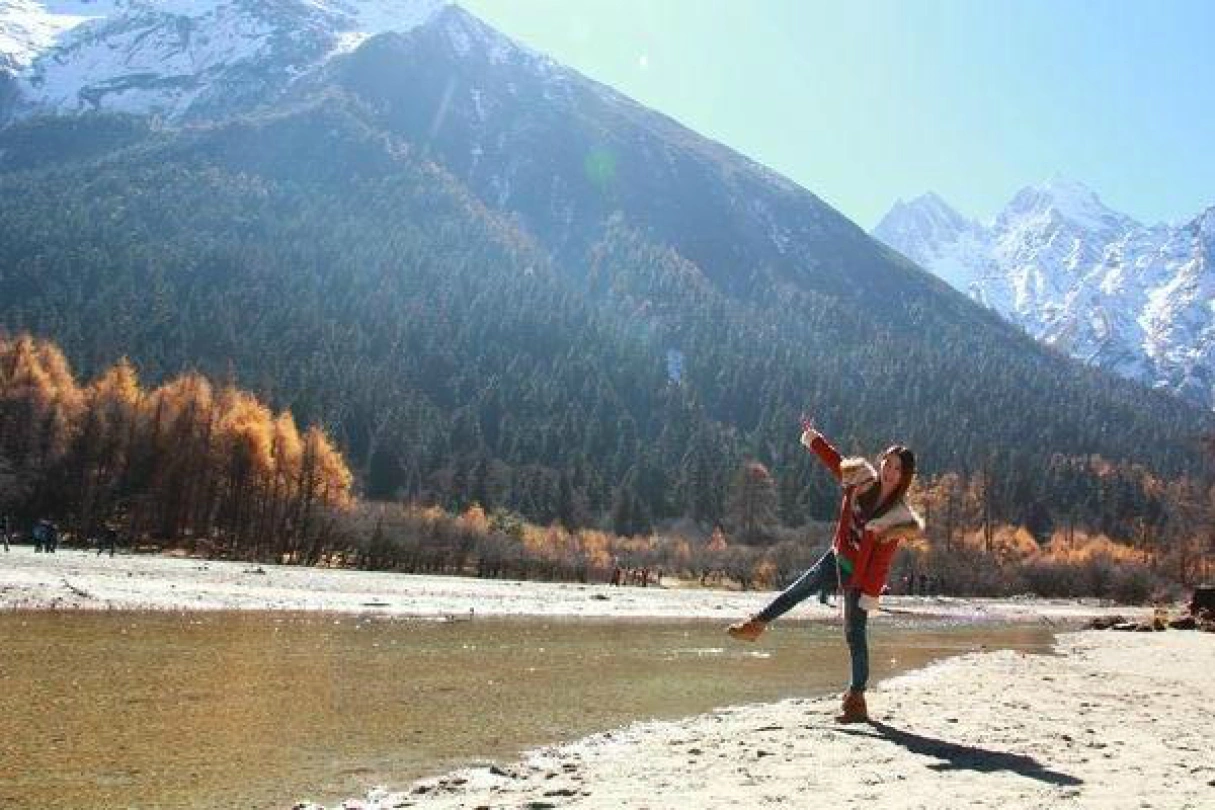
The sightseeing bus ride into Bipenggou was breathtaking. Red leaves framed the road, and in the distance, snowy peaks pierced the clear blue sky. The air was crisp and cold, carrying the scent of pine and earth. We hopped off at the first major stop and started hiking.
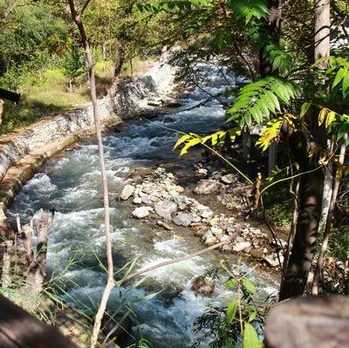
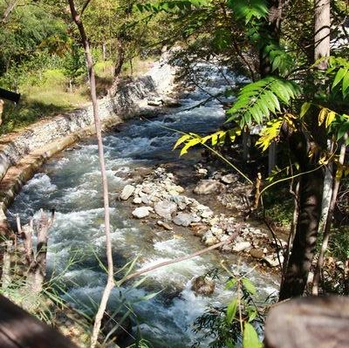
The trail wound through forests of maple and birch, their leaves a riot of red, orange, and gold. Every turn revealed a new vista: a cascading waterfall, a crystal-clear stream, a meadow dotted with wildflowers. We took hundreds of photos, but none could capture the feeling of being there—the peace, the awe, the sheer joy of the moment.
By midday, we reached the upper section of the valley, where the snowy peaks seemed close enough to touch. We sat on a rock, shared a simple lunch of bread and fruit, and watched the clouds drift over the mountains. It was perfect.
H2: FAQ About Bipenggou Late Autumn Road Trips
Q1: What is the best time to visit Bipenggou for autumn foliage?
 A: The peak autumn foliage season in Bipenggou typically runs from mid-October to early November. Late October offers the most vibrant red leaves and golden birches, with snowy peaks already visible in the background.
Q2: How do I get to Bipenggou from Chengdu?
 A: The most common route is by car via the Dujiangyan-Wenchuan Expressway (about 3-4 hours). Alternatively, you can take a bus from Chengdu's Chadianzi Bus Station to Li County, then transfer to a local bus or taxi to Bipenggou.
Q3: Do I need to book tickets in advance for Bipenggou?
A: Yes, especially during peak autumn season. Tickets can sell out by mid-morning. It's highly recommended to book online or through your accommodation at least a day in advance.
Q4: What should I pack for a late autumn trip to Bipenggou?
 A: Warm layers (temperatures can drop to near freezing at higher elevations), waterproof shoes, sunscreen, sunglasses, snacks, and a camera. The sun is strong even in autumn, so don't forget sun protection.
Q5: Can I visit Bipenggou in one day from Chengdu?
A: It's possible but very rushed. A weekend itinerary (2 days) is ideal to also explore nearby attractions like Taoping Qiang Village and Ganbao Tibetan Village without feeling hurried.
[Link: Bipenggou travel tips and packing list]
H2: Conclusion: Your Bipenggou Autumn Road Trip Awaits
Looking back, that spontaneous weekend escape to Bipenggou was more than just a trip—it was a reminder that the best adventures often come from the most unplanned moments. The traffic jams, the closed expressway, the last-minute ticket luck, the bonfire under the stars—all of it wove together into a story I still tell with a smile.
If you're dreaming of a late autumn road trip that combines red leaves, snowy peaks, and a touch of good fortune, Bipenggou is calling your name. Don't overthink it. Grab a friend, pack a bag, and hit the road. The mountains are waiting.
Ready to plan your own Bipenggou getaway? [Link: Book your Bipenggou tour or accommodation] Start your journey today—and who knows what serendipitous encounters await you.
Have you visited Bipenggou in autumn? Share your experience in the comments below!
You may also like