The Old Times of Chengdu: A 4-Day Slow Travel Guide to Finding Yourself Amidst the Hustle and the Hipster
Meta Description: Discover the soul of Chengdu beyond the hipster crowds. This 4-day itinerary covers panda encounters, Taoist temples, Kuanzhai Alley nights, and local secrets. Find your slow travel rhythm in the Land of Abundance.
Introduction: Why Chengdu Is a City You Never Want to Leave
My first longing for Chengdu came from a film — The Good Rain Season. To be honest, it wasn't a masterpiece, but the scenes of Du Fu's Thatched Cottage after a rainstorm, with that hazy, fresh atmosphere, felt like a piece of rice paper gently moistened by mist, softly unfurling in my heart. Later, a friend's photos from Jinli Ancient Street sealed the deal: at night, rows of red lanterns snaked along the ancient alleyways, like a string of dreams ignited by time. And so, this city, known as the "Land of Abundance," finally made it onto my travel list.
Someone once said that Chengdu is a city you never want to leave. I always wondered how much truth was hidden in that phrase. It wasn't until I set foot on this land of Bashu, letting time flow slowly through my fingers, that I finally understood — some places aren't meant to be seen with your eyes, but felt with your heart.
This Chengdu slow travel guide is for anyone seeking authentic experiences beyond the tourist trail. Whether you're a solo backpacker, a culture lover, or a foodie chasing Sichuan flavors, this 4-day itinerary will help you find your rhythm in the city's dual soul — ancient and modern, chaotic and serene.
Itinerary Overview: 4 Days, 4 Nights — Just the Slow City Life
This trip during the Qingming Festival lasted four days and four nights. I briefly considered venturing to the outskirts, but then I thought: instead of rushing around, why not give all my time to the city center and truly feel its pulse? I knew Jinli and Kuanzhai Alley would be packed, but the reality was even more "brutal" than I'd imagined — though that only made the quiet moments feel even more precious.
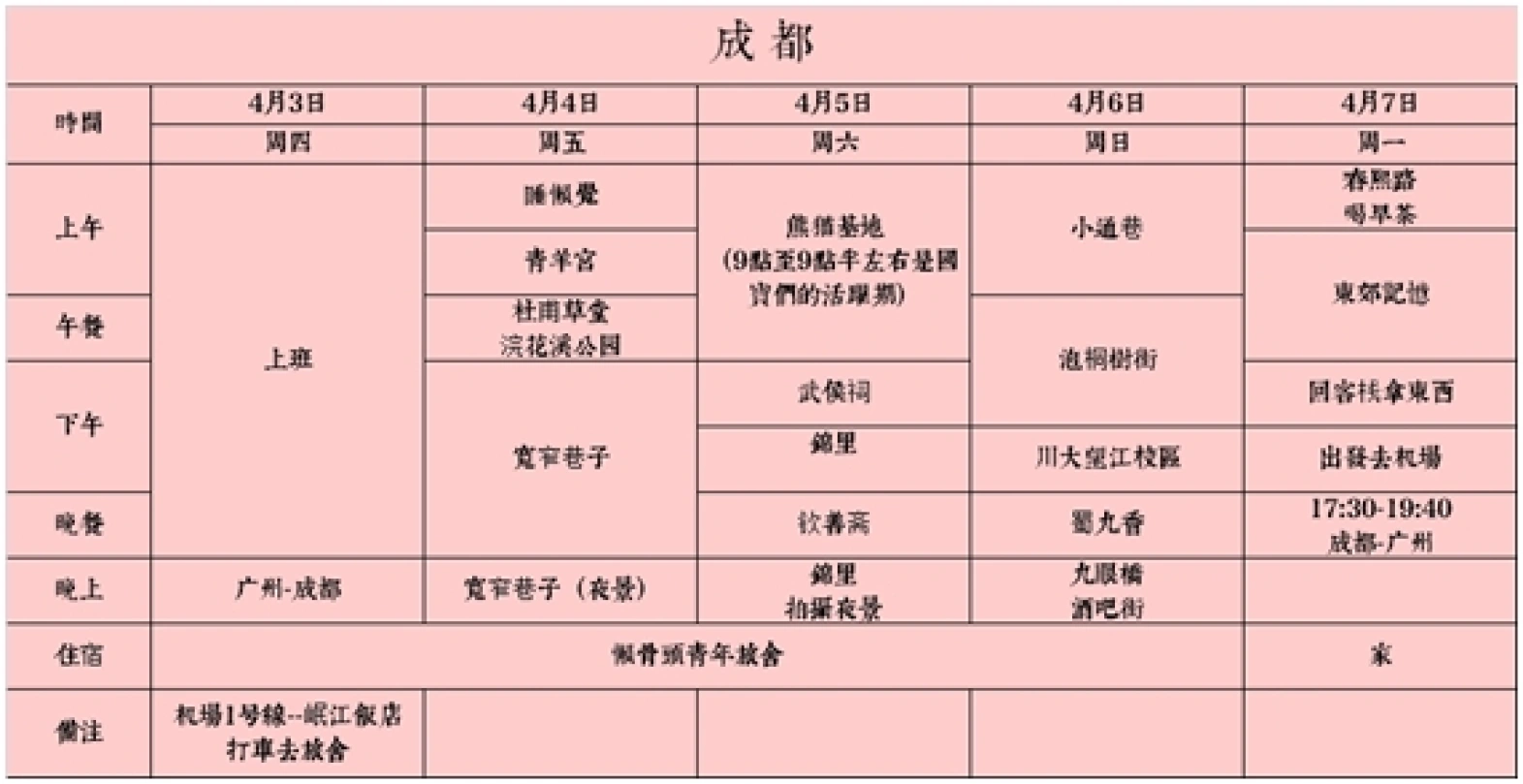
My Schedule: - Day 1: Qingyang Palace → Du Fu's Thatched Cottage → Kuanzhai Alley - Day 2: Panda Base → Wuhou Shrine → Jinli → Qinshanzhai (Old Pot Soup) → Lotus Mansion (Bar) - Day 3: Xiaotong Alley → Wutongshu Street → Sichuan University → Jiuyanqiao (Lan Kwai Fong) - Day 4: Chunxi Road → Eastern Suburb Memory
Accommodation: Lazyg Bones Youth Hostel (highly recommended — full of warmth and life) Flights: Round trip from Guangzhou to Chengdu, China Southern Airlines, 1,330 RMB Total Cost: No more than 2,500 RMB (including 1,000 RMB for food, drinks, and fun)
I arrived at Shuangliu Airport at midnight, checked in, and crawled into bed by 2 a.m. Luckily, I'd showered before leaving. I crashed immediately. Chengdu, I'm here.
Day 1: From a Taoist Temple to a Thatched Cottage, Then to the Alleyways of Everyday Life
Qingyang Palace: The First Incense of the Morning
I slept in a little, got up at nine, had breakfast at Zhong's Dumplings (Zhong Shui Jiao) across from the hostel, and took a taxi to Qingyang Palace (entrance fee: 10 RMB). As the foremost Taoist temple in western Sichuan, it's said to be a gathering place for immortals and where Laozi once preached. It's not big — you can finish in twenty minutes — but if you're into Taoist culture, an hour is enough to savor it.
When I arrived, there were hardly any people. The walls beside the temple were covered with tender green leaves — spring hadn't fully faded yet. A few elderly folks shuffled slowly, some burning incense at the altar. The incense was thick, and the burners were unique. I noticed that after burning, the incense would reveal characters — something I'd never seen in Guangdong's incense. It felt novel.
From Qingyang Palace, I took a taxi to Du Fu's Thatched Cottage. Taxis in Chengdu are ridiculously cheap, and if you use Didi or Kuaidi, there are even discounts — it's almost too good to be true.
Du Fu's Thatched Cottage: Poetry Blossoms After the Rain
The name alone — "Thatched Cottage" — feels poetic. This was the humble home Du Fu built for his family after fleeing the An Lushan Rebellion to settle in Shu. Though the current cottage is a reconstruction, it didn't dampen my expectations.

When I arrived, a new exhibition hall was under construction outside. I entered through a side gate and discovered a hidden world inside. A light rain had just fallen, leaving the bluestone paths damp. The flowers, washed by the rain, looked especially delicate. Sunlight lazily filtered through thick clouds, and the air was filled with the scent of earth and greenery.
In early April, Guangzhou's leaves had long passed their tender green, but the Thatched Cottage was bursting with spring — a riot of blossoms on every branch. Red and green intertwined in a sea of spring colors. In the bamboo grove, new shoots quietly peeked out; on the high eaves, green thrived. Yellow lanterns hung in many places, adding to the courtyard's tranquility. Walking through, you couldn't help but slow down, as if afraid to disturb the poet's thousand-year-old thoughts.
[Link: Best time to visit Du Fu's Thatched Cottage for fewer crowds]
Kuanzhai Alley: When Old Chengdu Meets New Life
By the time I left the cottage, it was past lunchtime, so I headed straight to my next stop — Kuanzhai Alley.
Kuanzhai Alley is about 500 meters long, consisting of three parallel old-style streets — Kuan Alley (Wide Alley), Zhai Alley (Narrow Alley), and Jing Alley (Well Alley) — along with their surrounding courtyard complexes. It was originally a typical residential area for old Chengdu locals, but after a 2008 renovation, it took a more upscale turn. While commercialization crept in, it also lost some of its original artistic charm. Still, that doesn't stop it from being a place worth strolling through.
Kuan Alley is the "leisurely life" zone, Zhai Alley the "slow life" zone, and Jing Alley the "new life" zone. You can sit in a courtyard sipping a bowl of traditional tea, enjoy an authentic Sichuan meal in a garden, or relax with a coffee on a tall stool, savoring the slow afternoon in the alley.
Before dark, I brewed a pot of jasmine tea and sat in the courtyard, watching the passersby. At that moment, time seemed to stand still. When I stepped out, dusk had fallen, and the lights were coming on. There was a pork knuckle shop in Jing Alley that was so good I craved it for days afterward. Everywhere, you could see exquisite details — from art on eggshells to various handicrafts — all impossible to ignore.
As night fell, the alley grew quieter, shedding its noise. Jing Alley, under the lights, looked especially enchanting and peaceful. I particularly liked a shop called "Next Door" (Gebizi). I can't say why, but the name felt oddly familiar and comforting. By 9:30 p.m., the crowds began to thin, and Kuanzhai Alley finally returned to its original self. Goodnight, Chengdu.
[Link: Top 5 hidden cafes in Kuanzhai Alley]
Day 2: Pandas, Jinli, and a Sleepless Night
Panda Base: Morning with the Adorable Gods
Seeing pandas in their hometown — just thinking about it was exciting. Though it was drizzling when I woke up, and the rain seemed to be getting heavier, it didn't dampen my eagerness to see the pandas.
A tip: After their 10 a.m. feeding, pandas start napping and aren't as active as in the morning, so go early. The Panda Base is located at Foton Mountain in Chengdu's northern suburbs, about 10 kilometers from the city center. From the hostel, it was a 30-minute drive.
The rain-soaked grass and flowers were even more enchanting. And those little chubsters — they were so cute it melted my heart. Pandas are only adorable when they're plump! Watching them wake up and tackle breakfast — munching on bamboo, gnawing on shoots, all kinds of fun — one even seemed to be picking its teeth after eating. It was hilarious.
A little fun fact: "Red pandas" aren't baby pandas — they're a different species. Baby pandas are just "panda cubs," so don't get confused. Watching the little pandas at play, I wanted to scoop them all up in my arms — they were just too cute. I couldn't stay calm.
But after a full circuit, I realized there weren't actually that many pandas on display. It was a bit less than I'd hoped, but still satisfying. I shouted out loud: I saw pandas in their hometown!
[Link: Panda Base vs. Dujiangyan Panda Valley — which is better?]
Jinli Ancient Street: Day and Night, Two Faces
After the panda base, I was exhausted. I went back to the hostel for a nap. Once rested, I ordered lunch at the hostel's bar and took some photos of the place. Lazyg Bones was cozy — small but thoughtfully decorated. The bartender was friendly, and the atmosphere felt like home.
By late afternoon, I headed to Jinli Ancient Street. Unlike Kuanzhai Alley's refined charm, Jinli feels more like a living, breathing marketplace. Daytime is for street food — try the spicy rabbit head, the crispy fried tofu, and the sweet osmanthus cake. Nighttime transforms Jinli into a lantern-lit dreamscape, perfect for photography and slow wandering.
I paired Jinli with a visit to Wuhou Shrine (entrance fee: 60 RMB), which sits right next door. The shrine honors Zhuge Liang, the legendary strategist of the Three Kingdoms era. Even if you're not a history buff, the ancient cypress trees and red walls create a meditative atmosphere.
By evening, I met up with a local friend at Qinshanzhai for Old Pot Soup — a Chengdu specialty. The broth simmered for hours, rich with herbs and pork bones. We followed it with a nightcap at Lotus Mansion, a bar that blends traditional Chinese aesthetics with modern cocktails. The night ended with a tipsy walk along Jinli's lantern-lit streets.
Day 3: Hidden Alleys, University Vibes, and Nightlife
Xiaotong Alley & Wutongshu Street: The Hipster Heart of Chengdu
Day three was all about exploring Chengdu's hidden alleys. Xiaotong Alley and Wutongshu Street are where the city's creative energy lives. Think independent bookstores, vintage clothing shops, and tiny cafes serving pour-over coffee. Unlike Kuanzhai Alley's polished facade, these streets feel raw and authentic.
I spent the morning hopping between shops, chatting with local artists, and sipping a flat white at a café called "No. 3." The barista told me that many of the buildings here date back to the 1950s, and the neighborhood was once a hub for factory workers. Today, it's a melting pot of old and new — just like Chengdu itself.
Sichuan University: A Stroll Through Academic Serenity
From the alleys, I walked to Sichuan University (Wangjiang Campus). The campus is a green oasis in the city center, with towering ginkgo trees and century-old buildings. I sat by the lotus pond for an hour, watching students cycle past and listening to birdsong. It was a perfect antidote to the morning's caffeine buzz.
Jiuyanqiao (Lan Kwai Fong): Chengdu After Dark
By nightfall, I headed to Jiuyanqiao, Chengdu's answer to Hong Kong's Lan Kwai Fong. The bridge itself is a landmark, but the real action happens along the riverbanks — bars, clubs, and street food stalls line the water. I grabbed a beer at a rooftop bar and watched the neon lights reflect on the water. It was loud, chaotic, and utterly captivating.
Day 4: Modern Chengdu and Industrial Heritage

Chunxi Road: Shopping and Street Food
My last day began at Chunxi Road, Chengdu's premier shopping street. It's commercial, yes, but it's also where you'll find some of the best street food in the city. I tried the dan dan noodles from a hole-in-the-wall shop, followed by a bowl of spicy tofu pudding. The energy here is infectious — a mix of locals and tourists, all chasing the same flavors.
Eastern Suburb Memory: Industrial Chic
The final stop was Eastern Suburb Memory (Dongjiao Jiyi), a cultural park built inside a former factory complex. Think Beijing's 798, but with a distinct Chengdu flair. The old red-brick buildings now house art galleries, design studios, and craft beer bars. I spent my last afternoon here, sipping a local IPA and watching the sunset paint the factory smokestacks orange.
FAQ: Answering Your Chengdu Travel Questions
Q: What is the best time to visit Chengdu? A: Spring (March to May) and autumn (September to November) offer mild weather and fewer crowds. Avoid Chinese national holidays like Qingming Festival or National Day if you want to skip the crowds.
Q: How many days do you need in Chengdu? A: 3-4 days is ideal for the city center. If you want to explore the outskirts (e.g., Leshan Giant Buddha, Mount Qingcheng), add 2 more days.
Q: Is Chengdu expensive for travelers? A: No. A budget of 2,500 RMB (including flights from Guangzhou) is enough for 4 days. Street food costs 10-30 RMB per meal, and taxis are cheap.
Q: What should I eat in Chengdu? A: Must-tries include mapo tofu, dan dan noodles, hot pot, rabbit head, and osmanthus cake. Don't skip the street food at Jinli or the old pot soup at Qinshanzhai.
Q: Is Kuanzhai Alley worth visiting despite the crowds? A: Yes, but go early morning or after 9 p.m. to experience its quieter side. Jing Alley is particularly charming at night.
Final Thoughts: Finding Yourself in Chengdu's Slow Rhythm
This Chengdu travel guide is more than an itinerary — it's an invitation to slow down. In a city where the past and future collide, where hipster cafes sit next to Taoist temples, and where pandas chew bamboo while skyscrapers rise in the distance, you'll find a rhythm that's uniquely yours.
So pack light, bring an open mind, and let Chengdu surprise you. Whether you're sipping tea in a courtyard at Kuanzhai Alley, watching pandas at dawn, or dancing until 2 a.m. at Jiuyanqiao, this city has a way of making you feel like you belong.
Ready to book your trip? Start with a flight to Chengdu Shuangliu Airport, book a bed at Lazyg Bones Youth Hostel, and let the slow life begin. Your Chengdu story is waiting.
Internal Linking Suggestions: - [Link: Best hostels in Chengdu for solo travelers] - [Link: How to get from Shuangliu Airport to city center] - [Link: Top 10 Sichuan dishes you must try] - [Link: Day trip from Chengdu to Leshan Giant Buddha] - [Link: Chengdu nightlife guide for first-timers]
Note: This article is based on a personal travel experience during Qingming Festival. Prices and availability may vary. Always check current conditions before traveling.


