Revisiting Xiling Snow Mountain: A Romantic Challenge in the Snow (Complete 2013 Year-End Hiking Guide)
Meta Description: Planning a winter hike to Xiling Snow Mountain? Discover our complete 2013 year-end hiking guide, including trail times, camping tips, and how to survive the cold with just one sleeping bag. Your ultimate Xiling Snow Mountain adventure starts here.
Introduction: The Unforgettable Pull of Xiling Snow Mountain
Some places you visit once out of curiosity, twice out of obsession. When my hiking partner Honghua and I stumbled down Xiling Snow Mountain on the last day of 2012, utterly exhausted, I swore: "I'm never coming back here in this lifetime!" Yet a year later, as the December 2013 winds swept through the streets of Chengdu, we inexplicably shouldered our packs again and set off for Xiling Snow Mountain. Perhaps that's the magic of snow-capped peaks—they torment you with cold and fatigue, then heal you with starry skies and sunrises.
This Xiling Snow Mountain hiking guide captures our unforgettable journey—complete with practical tips, trail times, and hard-earned lessons for anyone planning a winter adventure in Sichuan.
Pre-Departure Chaos: The Sleeping Bag Disaster
On the afternoon of December 27th, I was still staring blankly at my computer screen when I suddenly said to Honghua, "Let's go to Xiling Snow Mountain." Without hesitation, he opened the Chengdu ticketing website and started buying tickets.
First attempt: The 8:50 bus from Xinnanmen Station—too far, refund. Second attempt: The 9:30 bus from Chadianzi Station—only two tickets left! 37 yuan each (including 5 yuan insurance), first come, first served.
Just as I was secretly celebrating, a bombshell hit: all the accommodation points on the front mountain had been demolished! Friends either had to sit by a bonfire all night or pitch a tent to camp. I turned to Honghua and asked, "And the sleeping bag?" He said excitedly, "I bought one!" I took a deep breath. "Sweetheart, one? Are you sure it's one? So which one of us gets to sleep in it?"
He froze. Then it dawned on him. "Wait, why did I only buy one?"
"Sweetheart, were you dropped on your head as a kid?"
The tickets were bought—the arrow was already on the string. We had no choice but to head out with a single sleeping bag. That night, I rushed into Watsons to stock up on hand warmers, dashed to Hongqi Chain Store to pick up the bus tickets, then raided the supermarket for duck wings, bread, fruit, ham sausages, cookies, Want Want milk, and water. Honghua's backpack carried the sleeping bag, two raincoats, and food; my bag held a down jacket, hand warmers, sweaters, socks, and a camera. Both bags felt as heavy as lead—much heavier than last year.
Pro tip for Xiling Snow Mountain camping: Always double-check your gear list. One sleeping bag for two people is a recipe for a freezing night.
[Link: Essential winter camping gear checklist for Sichuan mountains]
Day One: Climbing Through the Snowstorm
From Chadiping to Jinhou Peak
On the morning of the 28th, Chadianzi Station was packed with people heading to Xiling Snow Mountain. I later found out it was the Ice and Snow Festival. The bus drove straight to the back mountain ticket office, but we got off early at Xiling Town. First, we grabbed lunch. The cured pork was so fragrant it almost made me cry, and the whole meal only cost 44 yuan—a steal compared to the overpriced clay pot rice noodles at the ski resort later.
There were hardly any people heading to the front mountain, so we had to hire a car. The driver quoted 50 yuan; I bargained him down to 30. As we passed the ticket office, my jaw dropped: why wasn't there any snow? Last year at this time, the snow was already thick. The ticket seller warned us, "You can only go as far as Colorful Waterfall on the front mountain—the road is closed." The driver quietly told us, "Don't worry, you can go around it. No one will stop you."
By the time we reached Chadiping, the snow was finally falling heavily. The driver kindly asked if we had a tent and left us his number: "If you don't want to go any further, just call me to pick you up."
Detailed Trail Times and Distances
At 1:00 PM, we officially started the climb. Here's the detailed itinerary and timings:
| Segment | Distance | Arrival Time |
|---|---|---|
| Mountain Gate → Frog Pool | 2.0 km | 1:38 PM |
| Frog Pool → Two Streams Junction | 1.0 km | 2:10 PM |
| Two Streams Junction → Zhangzi Cliff | 2.0 km | 3:20 PM |
| Zhangzi Cliff → Colorful Waterfall | 0.5 km | 3:29 PM |
| Colorful Waterfall → Osmanthus Forest | 1.9 km | 4:22 PM |
| Osmanthus Forest → Great Mountain Gate | 0.9 km | 5:39 PM |
| Great Mountain Gate → Cloud Viewing Platform → Jinhou Peak | 1.9 km | 7:30 PM |

Why do I remember the times so clearly? Because I took a photo at every scenic spot—checking the photos later made it easy. Why did the same distance take different amounts of time? Because the uphill sections were soul-crushing!
The crampons I bought online this time were excellent—snug-fitting and non-slip, far better than the cheap ones I bought at the mountain base last year, which had me constantly retying the straps.
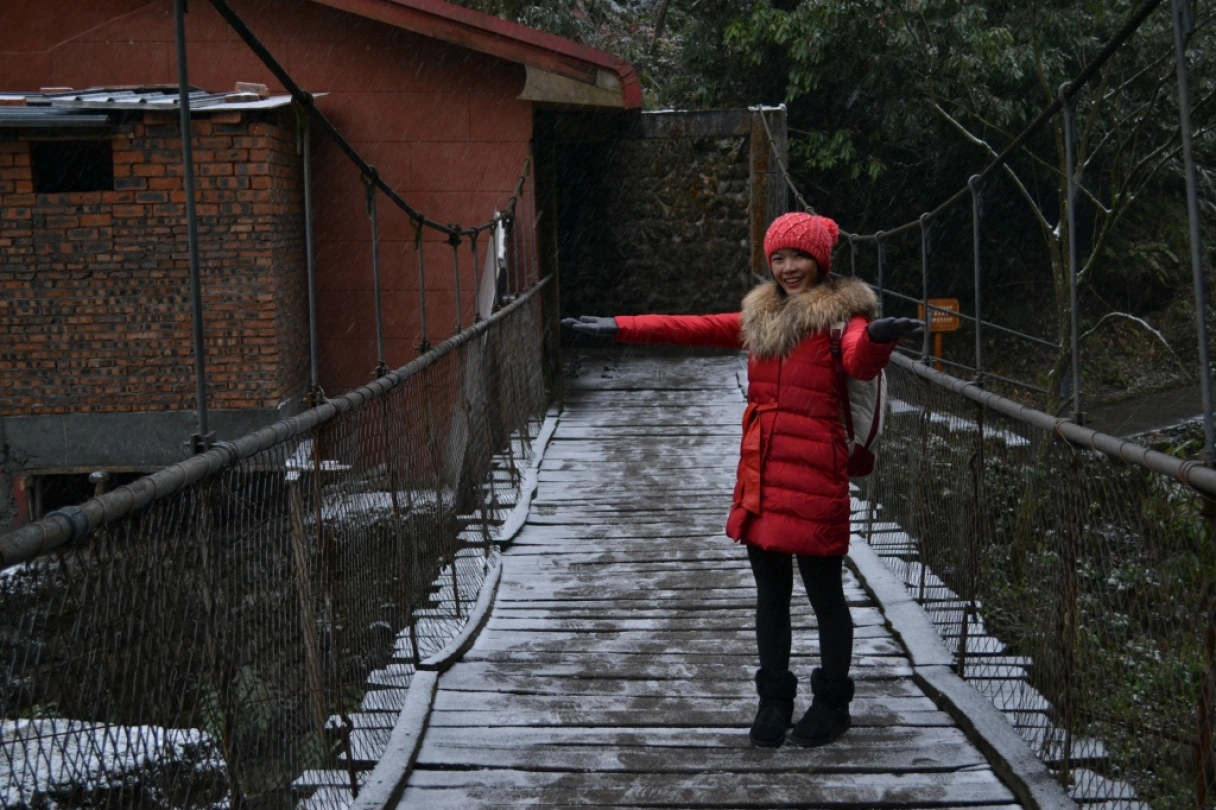
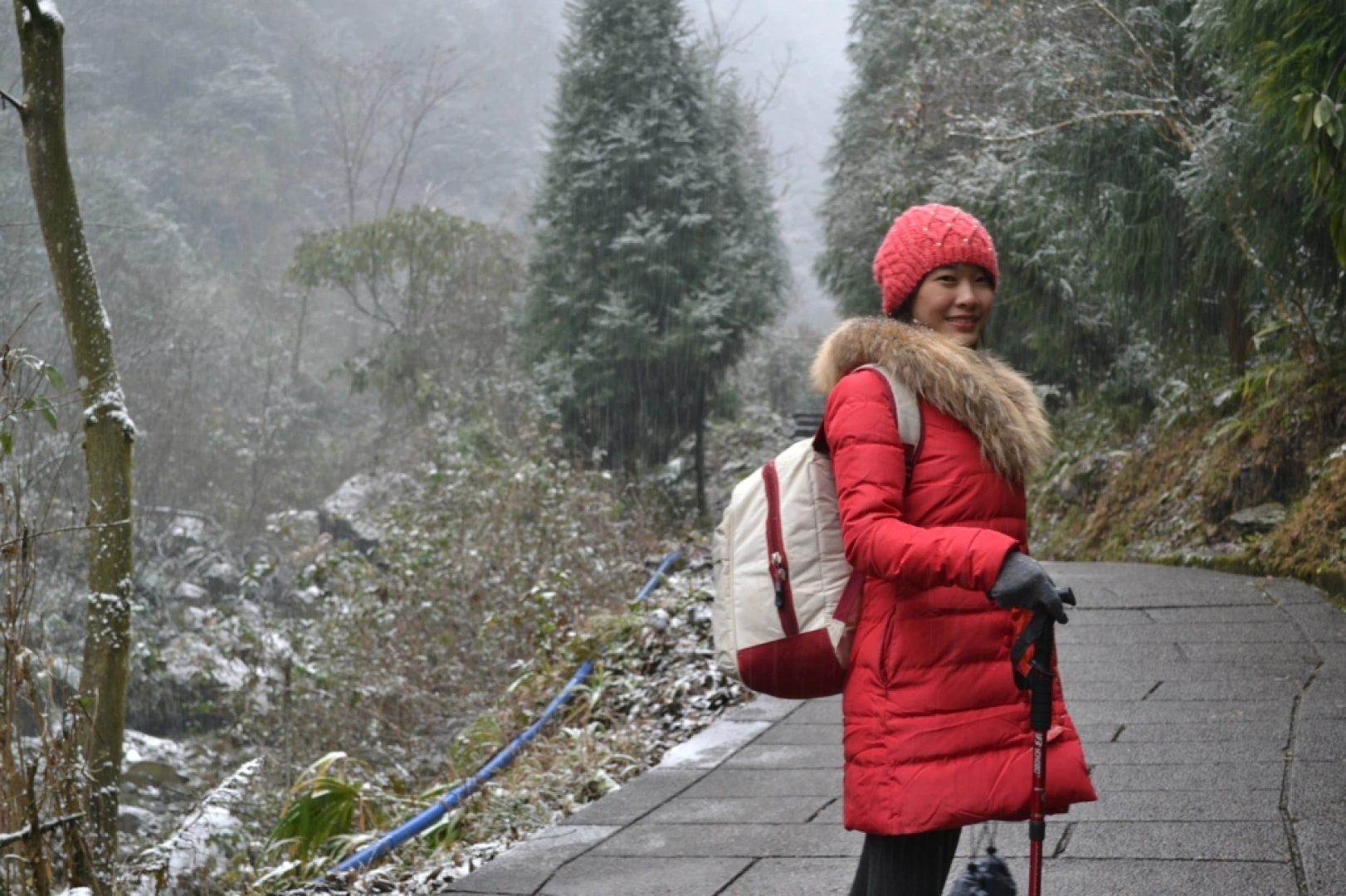
Colorful Waterfall hadn't fully frozen yet. The so-called "road closure" was bypassed by going around a big rock on the right. The snow really wasn't as deep as last year—last year the accumulation was heavy, while this year it was still falling. By the time we reached Osmanthus Forest, a thick layer of snow had built up on my hat.
[Link: Best crampons for winter hiking in Sichuan]
The Night at Jinhou Peak: Mice, Bonfires, and Frozen Romance
We arrived at Jinhou Peak at 7:30 PM. It was completely dark, and we decided to camp there. Several tents were already set up along the trail, and there was a small wooden cabin nearby packed with people warming themselves by a fire. The smoke stung our eyes and made us tear up. We had dinner inside and dried our soaked hats and fleece collars by the fire. Honghua went out to explore and came back excitedly saying he'd found "luxury accommodation"—a corner where firewood was stored.
We used a discarded raincoat and plastic sheeting to make a windbreak for the entrance, spread the two raincoats on the ground, and then just stared at that lonely sleeping bag. Finally, I crawled in first, and Honghua squeezed in after me. The zipper only reached our knees. We lay on our sides. He wore his own down jacket on his upper body, then draped my down jacket over himself, shivering the whole time.
Then Honghua suddenly asked, "Do you think there are mice here?"
"Probably not. It's so cold, they'd all be frozen to death," he answered himself.
No sooner had he spoken than a little mouse scurried over!
"Sweetheart, could you not jinx things like that?"
We packed our food into the bags, but people were talking loudly all night, so we couldn't sleep at all. In the early hours, we got up to start a fire. It took over an hour—the fire kept going out, then flaring up, then dying again. I was freezing the whole time. Eventually, we got it going, but the space was too big, and we could barely feel the warmth.
At 3:50 AM, the alarm went off. We'd slept for less than half an hour, woken by the cold. We asked the couple with the tent next to us, and they said they were so cold they hadn't slept at all and had even gone to the cabin to warm up by the fire.
But that night's starry sky was breathtakingly beautiful—worth every bit of the suffering.
Day Two: Charging Toward Riyueping
The Toughest Stretch of the Xiling Snow Mountain Hike
We set off for Hongshibao at 4:50 AM. After walking less than ten minutes, I was gasping for air—I'd had myocarditis last year, and the aftereffects still lingered. Honghua took my backpack and carried it on his chest, gave me his trekking pole, and slowed down. Only then did I recover. We reached Hongshibao at 6:40 AM and found even more tents set up there.
Then came the hardest section of the entire trip: Hongshibao to Riyueping. It was all steep slopes. I kept stopping to rest, kept struggling to breathe. When I finally reached Riyueping, I leaned against the railing for several minutes before I could catch my breath.
Last year, I thought the stretch from Jinhou Peak to Hongshibao was the most exhausting because we'd done it in one go. This year, I realized that Hongshibao to Riyueping was even harder because we hadn't rested properly the night before. So here's a friendly tip: if you stay at Jinhou Peak, the next day's climb from Hongshibao to Riyueping will be brutal; if you stay at Hongshibao, the previous day's hike from Jinhou Peak to Hongshibao will be brutal. Take your pick.
The cold at the summit was unbearable. The ends of my hair were frozen solid, all my photos captured the frost on my eyelashes. But the sunrise over Riyueping—a sea of clouds painted in gold and pink—made every frozen moment worthwhile.
[Link: Best sunrise viewpoints on Xiling Snow Mountain]
Frequently Asked Questions About Xiling Snow Mountain Hiking
1. Is Xiling Snow Mountain suitable for beginners?
Xiling Snow Mountain offers trails for different skill levels. The front mountain route (Chadiping to Riyueping) is moderately challenging, with steep sections and high altitude. Beginners should prepare with proper gear, allow extra time, and consider hiring a guide. The back mountain ski resort area is more accessible for casual visitors.
2. What is the best time to visit Xiling Snow Mountain for snow?
December through February offers the most reliable snow conditions. However, snow depth varies year to year. Our 2013 trip had lighter snow than the previous year, so check recent conditions before departing. The Ice and Snow Festival typically runs from December to March.
3. Do I need camping gear for the front mountain hike?
Yes, if you plan to stay overnight. Accommodation on the front mountain has been demolished, so you must either camp or descend the same day. Essential gear includes: a warm sleeping bag (rated for -10°C or lower), a four-season tent, crampons, trekking poles, hand warmers, and waterproof clothing. Don't make our mistake of bringing only one sleeping bag!
4. How do I get from Chengdu to Xiling Snow Mountain?
Take a bus from Chadianzi Station (茶店子车站) in Chengdu. Buses run regularly, especially during peak season. The journey takes approximately 2-3 hours. Tickets cost around 37 yuan including insurance. For the front mountain, you'll need to arrange a local car from Xiling Town.
5. What should I pack for a winter hike on Xiling Snow Mountain?
Pack layers: thermal base layer, fleece, down jacket, and waterproof outer shell. Bring crampons, trekking poles, a headlamp, hand warmers, high-calorie snacks, plenty of water, and a thermos for hot drinks. Don't forget a camera—the starry skies and sunrises are unforgettable.
Final Tips for Your Xiling Snow Mountain Adventure
- Start early: Leave Chadiping by 1:00 PM at the latest to reach Jinhou Peak before dark.
- Bring extra socks: Wet feet can ruin a hike. Pack at least two pairs of wool socks.
- Negotiate car prices: Drivers often quote high. Bargain politely—30 yuan is a fair price from Xiling Town to Chadiping.
- Check weather forecasts: Snowstorms can make trails dangerous. Be prepared to turn back if conditions worsen.
- Respect your limits: If you're feeling unwell (especially with altitude or heart conditions), slow down and communicate with your hiking partner.
Ready for Your Own Xiling Snow Mountain Challenge?
Xiling Snow Mountain isn't just a hike—it's a test of endurance, a lesson in preparation, and a reward of breathtaking beauty. Whether you're a seasoned trekker or a first-time winter camper, this mountain will leave you with stories to tell for years.
Plan your trip today. Check bus schedules from Chengdu, pack your gear (double-check that sleeping bag!), and set out for an adventure that will freeze your fingers but warm your soul.
Have you hiked Xiling Snow Mountain? Share your experience in the comments below—we'd love to hear your tips and stories!
[Link: Winter hiking safety guide for Chinese mountains] [Link: Top 10 winter hiking destinations near Chengdu]
This guide is based on a December 2013 trip. Trail conditions, accommodation availability, and prices may have changed. Always check current information before planning your hike.