Beyond the Red Houses: A Soul-Stirring Journey to the Larung Gar Buddhist Academy
Meta Description: Discover the world's largest Buddhist academy in Sertar, Sichuan. A complete travel guide to Larung Gar—including altitude tips, sky burial etiquette, and photography advice.
There are places you visit, and there are places that visit you. Sertar—or more precisely, the Larung Gar Five Sciences Buddhist Academy—is undeniably the latter. Tucked away in a remote valley of Sichuan's Garzê Tibetan Autonomous Prefecture, this sprawling crimson city of faith has drawn me back not once, not twice, but three times. And each time, I leave with more questions than answers—which, I've come to realize, is precisely the point.
In May 2014, I led my second group to this sacred site, marking my third personal pilgrimage to what many call the world's largest Buddhist academy. What struck me most was how little the essence had changed since my first visit three years earlier. The same dense red houses clinging to steep hillsides. The same murmured prayers carried by the wind. The same gentle smiles from robed monks and nuns. What had changed, however, was the growing number of visitors in brightly colored outdoor gear—a testament to the academy's rising fame through social media and travel blogs.
I'll admit, I hesitated before writing this article. Would more exposure bring more crowds, disturbing the tranquility that makes this place so special? Then, during a prayer wheel rotation at the Mani Temple, I met a Han Chinese nun who had lived at the academy for sixteen years. She had witnessed the academy's expansion from a single hillside to several slopes, watched pilgrims and photographers pour in from every corner of the globe. Her response surprised me: "This is good," she said. "Whether you're a believer or not, everyone who comes here absorbs at least a little Buddhist culture. Spreading the Dharma is, after all, the academy's founding purpose." She kindly directed me to the official website, Zhi Bei Fo Wang, for those seeking deeper study.
So here I am, finally sharing this story—images sorted, thoughts settled, heart full.
What Makes Sertar So Extraordinary?
Perched at 3,700 meters above sea level, approximately 18 kilometers southeast of Sertar County in Garzê Prefecture, the Larung Gar Five Sciences Buddhist Academy is the largest institution of its kind for the Nyingma school of Tibetan Buddhism. Its history stretches back to 1880, when the visionary Dorje Drol held teachings here. In 1980, the revered Dharma King Jigme Phuntsok Rinpoche re-established the academy on the very site where the First Dungse Rinpoche had once meditated. Official recognition came on May 15, 1987, when the Tenth Panchen Lama personally wrote to the Sertar County government, granting approval and bestowing the academy's name in his own calligraphy.
Today, Sertar is celebrated as both a Buddhist holy land and a photographer's paradise—though a crucial caveat applies: never photograph monks or nuns without their explicit permission. A simple smile and a nod of inquiry can open doors to genuine connection.
My Gear for This Journey
- Camera: Canon 5D Mark II
- Lenses:
- Samyang 8mm fisheye (budget-friendly but fully manual—great for dramatic distortion if you have experience)
- Sigma 35mm f/1.4 (my go-to for portraits; most of the human images here come from this lens)
- Canon 24–105mm f/4L (the versatile travel lens, handling landscapes and portraits with equal ease)
- Tripod: Weifeng entry-level
- Shutter Release: Budget-friendly model, used for star trails and time-lapse photography
Practical Planning: Getting There and Staying Well

Recommended 4-Day Sertar Itinerary
| Day | Route | Notes |
|---|---|---|
| 1 | Chengdu → Li County → Barkam → Guanyinqiao | Good road conditions throughout |
| 2 | Guanyinqiao → Wengda → Sertar | 60% rough road |
| 3 | Sertar → Wengda → Guanyinqiao | Return leg |
| 4 | Guanyinqiao → Barkam → Li County → Chengdu | Homeward bound |
Crucial Advice: Despite the relatively short distance, the roads—especially National Highway 317 between Guanyinqiao and Wengda—are in appalling condition. Avoid this stretch entirely during the rainy season (June to August). If you're not up for driving, buses depart from Chengdu's Chadianzi Station daily at 6:20 AM. The journey takes about 15 hours, arriving around 9:00 PM. Ask the driver to drop you at the academy's entrance rather than continuing to the county town.
[Link: How to plan a Sichuan Tibet Highway road trip]
Where to Sleep in Sertar
Guanyinqiao: Accommodation options are plentiful and surprisingly comfortable. Even modest-looking guesthouses often hide luxurious interiors—I once had a standard room larger than my living room at home. No need to book ahead outside peak season.
Sertar Academy: Choices are limited. The best option is the Larung Hotel, but at nearly 4,000 meters, altitude sickness can be severe. If symptoms become unbearable, descend immediately to the guesthouses at the academy's base—they're simpler but at lower elevation.
Recommended: In Guanyinqiao, I stayed at a four-star hotel that set a new standard for comfort in the region.
Eating Well in the High Plateau
Guanyinqiao: A Chongqing-style Sichuan restaurant serves excellent dry pot (干锅)—a slow-cooked clay pot dish with meat, vegetables, and aromatic spices. Pro tip: the cooking process takes nearly an hour, so call ahead at 15108178731.
Sertar Academy: Don't expect gourmet dining, but the Sichuan restaurants lining the streets are run by chefs from Chengdu, Dujiangyan, and Zigong—they know their spices. For the adventurous, there's also a Tibetan restaurant serving authentic momos (Tibetan dumplings), yogurt, and butter tea. Personally, I stick with the yogurt and tea.
Day 1: Chengdu to Guanyinqiao
Our group of twenty departed Chengdu at 8:00 AM. Some were veterans of this route; others had no idea where Sertar was until their friends dragged them along. By the time we'd driven all day without reaching our destination, the latter group was starting to suspect they'd been tricked.
The only thing that caught my eye was a restaurant's ceiling lamp—beautifully crafted from what turned out to be sheep horns. A small reminder of the artistry hidden in everyday objects.
Guanyinqiao serves as a perfect rest stop. Its Tibetan Buddhist temple, Tukyi Qoinpo Guanyin Temple, is considered the "second Potala Palace" in Tibetan Buddhist circles. We skipped the climb this time, opting instead for a hot shower and a good meal.
Day 2: Guanyinqiao to Sertar Academy
We set out at 6:30 AM to reach the celestial burial site by noon. Though only 200 kilometers away, the road conditions were abysmal—large vehicles crawled at 30 km/h. Watching the landscape outside the window, I pitied anyone traveling during the rainy season.
We arrived at the sky burial ground (known locally as "Shitolin") by 1:00 PM. Compared to my first visit three years earlier, the site had become significantly more developed. I couldn't help but wonder: would it eventually charge admission like Langmusi? That would feel like a betrayal of its sacred purpose.
[Link: Tibetan sky burial traditions and etiquette]
A Note on Respect: Some things should never be photographed. The remains of the deceased deserve dignity. As a visitor, it's your responsibility to know the boundary between observation and intrusion.
The sky burial ceremony typically takes place between 1:30 and 2:30 PM. On busy days, there may be over a dozen bodies; on quiet ones, just two or three. For Tibetan Buddhists, this is the most sacred form of funeral—the final act of generosity, offering one's body to feed the vultures. The family watches silently as the sky burial master cuts the flesh, and the vultures circle overhead, waiting for the signal. Not a single tear is shed. It's a profound lesson in detachment and faith.
Entering the Academy: A World of Red
After the burial, we headed to the academy. Our bus could only go as far as the parking lot; from there, we hired a van to transport luggage and began the uphill hike. Carrying gear at 3,700 meters was no small feat—every step reminded me of the thin air.
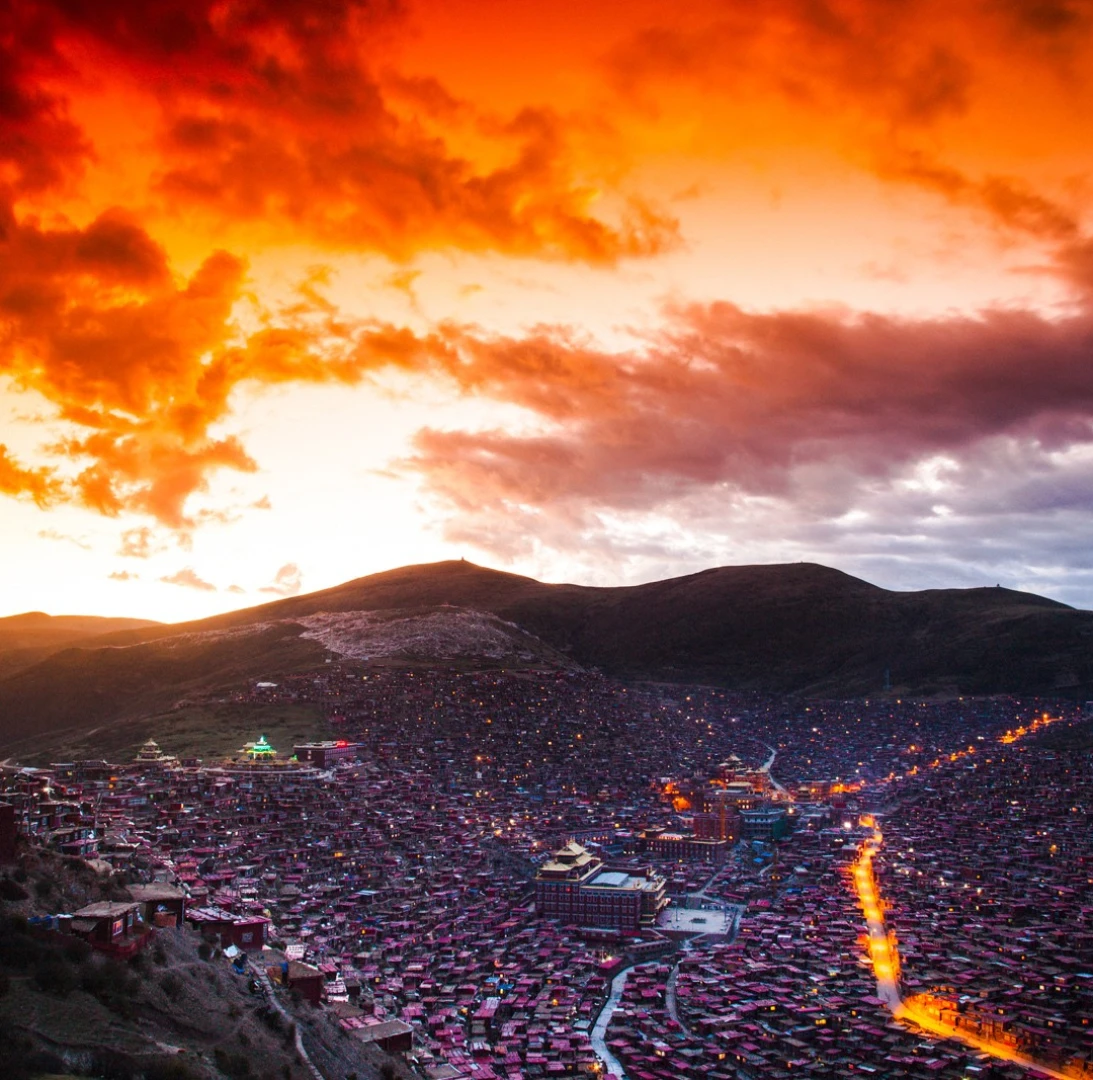
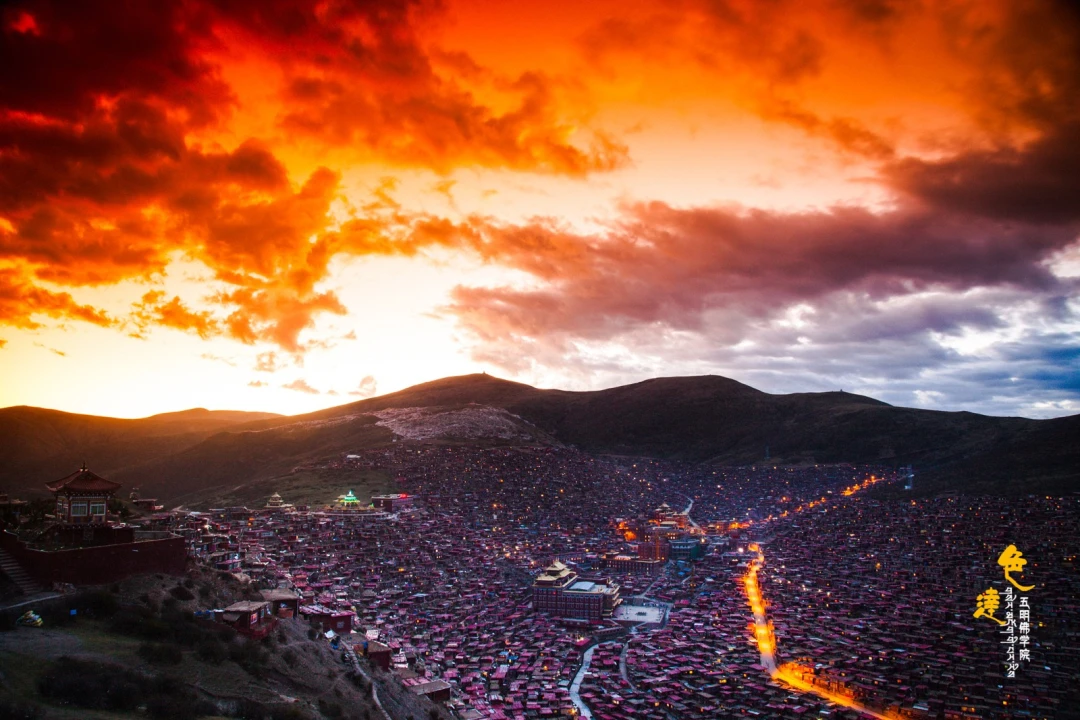
But then, the red houses appeared. Thousands upon thousands of crimson huts cascading down the valley, each one a monk or nun's simple home. The sight is overwhelming—not just visually, but spiritually. This is a city built on faith, where every structure, every prayer flag, every chanted syllable points toward enlightenment.
Photography Tips for Larung Gar

- Best time for photos: Early morning (6:30–8:00 AM) for soft light and mist rising from the valley
- Golden hour: Sunset paints the red houses in even deeper hues
- Respectful portraits: Always ask permission. A nod and a smile work wonders
- Wide-angle lens: Essential for capturing the scale of the valley
- Avoid: Photographing prayer wheels or religious ceremonies without permission
[Link: Best photography spots in Sichuan's Garzê region]
Day 3: Immersion at the Academy
We spent the entire day exploring the academy's winding alleys. Every corner revealed something new: a young monk debating scripture, a nun spinning prayer wheels, a group of pilgrims prostrating before the main temple.
The Mani Temple is the heart of the academy. Here, thousands of prayer wheels line the corridors, each one filled with mantras. Walking the circuit and spinning every wheel is a meditation in itself. The sound—a constant, gentle creaking—becomes the soundtrack of Sertar.
For those seeking deeper study, the academy offers Dharma teachings in both Tibetan and Chinese. Visitors are welcome to attend public lectures, though silence and respect are expected.
Day 4: The Return Journey

Leaving Sertar is always bittersweet. The drive back to Chengdu feels shorter than the journey in—perhaps because the mind is still processing what it has witnessed.
The final image I carry: a young monk standing on a rooftop at sunset, his robe catching the last light, his gaze fixed on the distant mountains. He didn't say a word. He didn't need to.
Frequently Asked Questions About Larung Gar Buddhist Academy
1. Is the Larung Gar Buddhist Academy open to foreign tourists?
Yes, the academy is open to all visitors, including foreign tourists. However, you must carry your passport at all times, as checkpoints are common on the route. Some areas within the academy may be restricted to monks and nuns only.
2. What is the best time to visit Sertar?
 The best time is May to October, when temperatures are milder and roads are passable. Avoid the rainy season (June–August) if possible, as National Highway 317 becomes treacherous. October offers stunning autumn colors against the red houses.
3. How do I prevent altitude sickness at 3,700 meters?
- Spend a night at Guanyinqiao (2,600m) to acclimatize
- Avoid alcohol and heavy meals on arrival
- Drink plenty of water and ginger tea
- Carry Diamox (acetazolamide) if prescribed
- Descend immediately if symptoms become severe
4. Can I photograph monks and nuns at the academy?
 Yes, but always ask permission first. A simple smile and a nod of inquiry can open doors. Never photograph religious ceremonies, prayer wheels, or the sky burial site without explicit consent. Some monks may decline—respect their wishes.
5. Is there accommodation inside the academy?
The Larung Hotel is the only accommodation within the academy grounds. It's basic but functional. For better comfort, stay at guesthouses at the base of the mountain (lower altitude) or in Guanyinqiao (2 hours away).
Final Reflection: Why Sertar Stays With You
Three visits, and I still haven't cracked the code of Sertar. Perhaps that's the point. The academy doesn't offer easy answers—it offers questions. About faith, about detachment, about what it means to live a life of purpose.
Whether you're a devout Buddhist, a curious traveler, or a photographer seeking the perfect shot, Larung Gar will change you. Not because it's beautiful (though it is), but because it's real. The prayers are real. The devotion is real. The altitude headache is real.
And that's exactly why you should go.
Ready to plan your pilgrimage? [Link: Book a guided tour to Sertar and Garzê]
Need help with gear? [Link: Best cameras for high-altitude travel photography]
Want to learn more about Tibetan Buddhism? [Link: Introduction to Nyingma school and Dharma King Jigme Phuntsok Rinpoche]
Have you visited Larung Gar? Share your experience in the comments below. If you're planning a trip, feel free to ask questions—I'll do my best to help.
You may also like


